

Stranger Things ends with heart, soul, and mind to match viewership
Humanist analysis on the finale we needed

(Note - spoilers throughout)
As a writer/artist myself, I often can’t help becoming a critic when I consume other art. Since I have gone through the incredible process of creating content for people to consume, I automatically start to wonder what was going on in each creator’s mind. What, if anything, were they trying to get across with their creation? If it seems like there’s nothing there beyond flashy spectacle, if there’s no soul or point to the thing, it simply doesn’t land for me. As Nina Simone said, “how can you be an artist and not reflect the times?”
Stranger Things is a massive cultural phenomenon. Something so popular often comes with standard banality: the typical storyline, the Americanized tropes, the usual mundane brainrot. But something so popular, for once, bursted with soul, and featured a powerful brand of politics that, if taken seriously from a people’s perspective, could save the world. Unlike “Department of War”-funded Marvel hogwash, the US military was a villain in Stranger Things. When Eleven took down the helicopter in season 4, that’s when I knew definitively the show had the juice and the Duffer brothers had the guts.
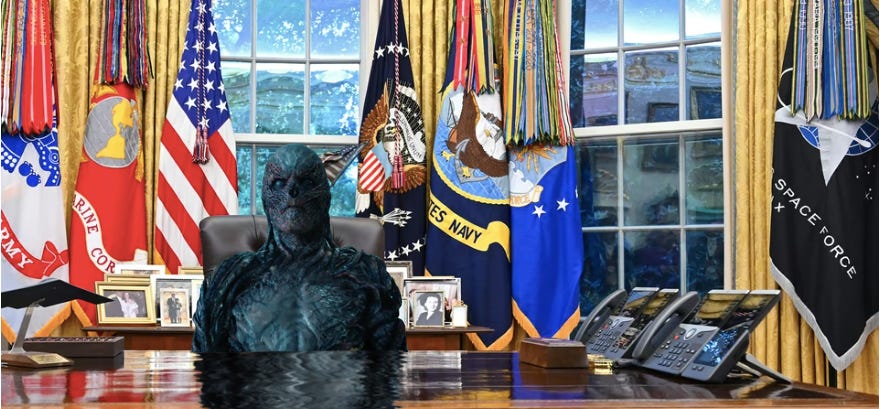
When I say that the US military deserves to be scrutinized, I am not talking about viewing my friends and family members in the service as villains. I am not talking about demonizing the kids conned into joining the military, approached at college fairs by recruiters leading with “how will you afford college?” (this is something I have seen with my own eyes multiple times). Every country needs some sort of standing military force, so I am not talking about the people who (often coerced) sign up for such a thing. I am talking about viewing as a problem the so-called elites who set the agenda and objectives.
In Stranger Things, the central goal of the US military was to take Eleven to “use against the Russians”. This of course is based on the lazy and xenophobic presumption “Russia bad”. This adversarial baseline position, that there’s an evil enemy lurking and therefore our national priority must be to preemptively stop The Other before they commit some undefined ambiguous evil deed is literally what governs American society. The real evil lunatics who sell weapons, run banks, set budgets, and make laws desire a neverending military conflict either because it’s profitable or because they’re overgrown losers playing GI Joe (looking at you Pete Pigseth). This is the military industrial complex.
In the Stranger Things universe, there was a god damn Mind Flayer in an alternate dimension set to destroy planet earth as we know it and replace it with some fucked up Vecna-envisioned “upsidedown” world and the US was sooner worried about… fighting Russia. It would be laughable if we didn’t witness the same damn scenario - in bipartisan fashion - in our own world.
While so much else is deteriorating in our society, what do the powers that be describe as the biggest problems plaguing society? When it’s a Republican administration, they’d have you believe the bane of human existence is a handful of transgender kids playing sports with girls, or guys in speed boats in the Atlantic Ocean, or maybe an immigrant farmer trying to raise his kids in a country that wasn’t destroyed by US imperialism. They’ll serve up this mindless bullshit with maybe a side of China xenophobia. Democrats had us believing The World’s Biggest Problem was Russia doing memes and “stealing our democracy”, or some “deplorable” with a MAGA flag, as they funded and abated an ongoing genocide no less. In the same way that our brave heroes in Stranger Things better understood what the actual problem was in their universe, the average American absolutely understands that issues like clean water, environment, wealth/power inequality, staying the hell out of other country’s business, etc. are far bigger issues than those that the powerful point at; and I would argue the things they point at are born out of their own ignorance or intentionally wielded as a distraction to continue the mindless quest for profit and dominance at any cost and at our expense.
The US military as an entity is also one of the biggest emitters of CO2 on the planet (more than entire countries) all in service of the same misguided, destructive agenda in Stranger Things. When we keep in mind the imperialistic objectives of the US military paired with the environmental destruction it’s causing to get there, it’s a double whammy. It’s destroying other countries in the short term, and life in general in the long term. So, yeah, when Eleven - one of the most selfless, excellent, and admirable characters in my recent memory - destroys a US chopper acting upon such irrational and destructive goals, we’re all correct to applaud for a multitude of reasons in the show and beyond. In the same way the objectives of the US military must be lambasted due to recent events surrounding Venezuela (or Iraq, Latin America, Congo, Laos, Cambodia, etc. etc. before it), so did the incompetent, hubristic version of the US military in the show.
Finally, we could be heroes indeed. On the same week Stranger Things ended, Zohran Mamdani delivered an inauguration speech containing the line, “We will replace the frigidity of rugged individualism with the warmth of collectivism.” Though the right wing pundits were silent when Donald Trump illegally bombed Venezuela and captured its president (or murdered random people in the ocean leading up to this escalation for that matter), they did mental gymnastics explaining how human beings - a communal species - are better off foregoing community in favor of isolated individualism. Surprisingly, I didn’t see “Vecna” in any bylines, but boy would he have been proud of some of these incredibly tragic arguments. High-profile people like the Duffer brothers and Mamdani must to continue illustrating such principals so the confused and/or psychotic libertarians can embarrass themselves trying to explain why being on your own is somehow better than being a part of a community, and we the people need to listen to them and act accordingly.
The individualist Henry - a character hellbent on the idea that humans are inherently evil - wanted to destroy the world as we know it specifically because he was either unable or unwilling to work through his own personal trauma and issues. Because he felt evil himself, he projected that theory onto the rest of humankind. Gee, I wonder if the pundit class that continues to ignore a basic value such as the Golden Rule might have their own serious issues to work through rather than manufacture public consent for war and destruction? So much for individualism on this score. Throughout the series, and especially in the immensely satisfying ending, the notion that individualism is greater than community is proven brutally wrong again and again. Crucially, this is not merely a Hollywood fantasy, either - I am certain it’s how most human beings actually feel about things. I don’t believe it’s hyperbolic to point out that anyone who argues in earnest for rugged individualism is not only in the minority, but potentially deeply damaged and in need of such community (or a good therapist).
The selfless Eleven knew what was coming had she remained alive: a US military harassing her and anyone who knew her until they had her in their clutches, just to use her in their ignorant quest for world domination (against a fellow nuclear superpower no less - all too often we forget nuclear war would end life on this planet) while, unbeknownst to them, a force beyond their capacity to handle angled to actually destroy the world. Eleven knew, with the help of her wise sister, that the only way her friends would ever know peace would be if she died in front of the psychopaths who sought to kidnap her - but not before saving a world she knew she herself would never even get to fully enjoy. We root for her because she is the antithesis of Henry’s cold individualism, the absurd notion that humankind is inherently evil. She is a selfless hero who acts on behalf of her beloved community, a community she loved so much she gave her life to save (as you can see, though I am glad it was included, I don’t buy Mike’s story). In a world where a striking amount of people made the mistake of martyrizing Charlie Kirk, I am glad there is Stranger Things to remind them what an actual Christ-like martyr might look like.
Stranger Things is a rare blockbuster that has the heart to match the viewership. On an entertainment level I think it’s got to be the greatest series finale of all time. But since America is always bursting with (probably far too much) content and entertainment, it is vital for Americans to think deeply about a show that dares to challenge status quo consensus surrounding individualism, imperialism, and xenophobia. As in Stranger Things, the powers that be in their narrow objectives directing the US military had no vision or ability, let alone awareness, to address the actual issues of the day, only the people did; and this may be the greatest lesson Stranger Things has to offer.